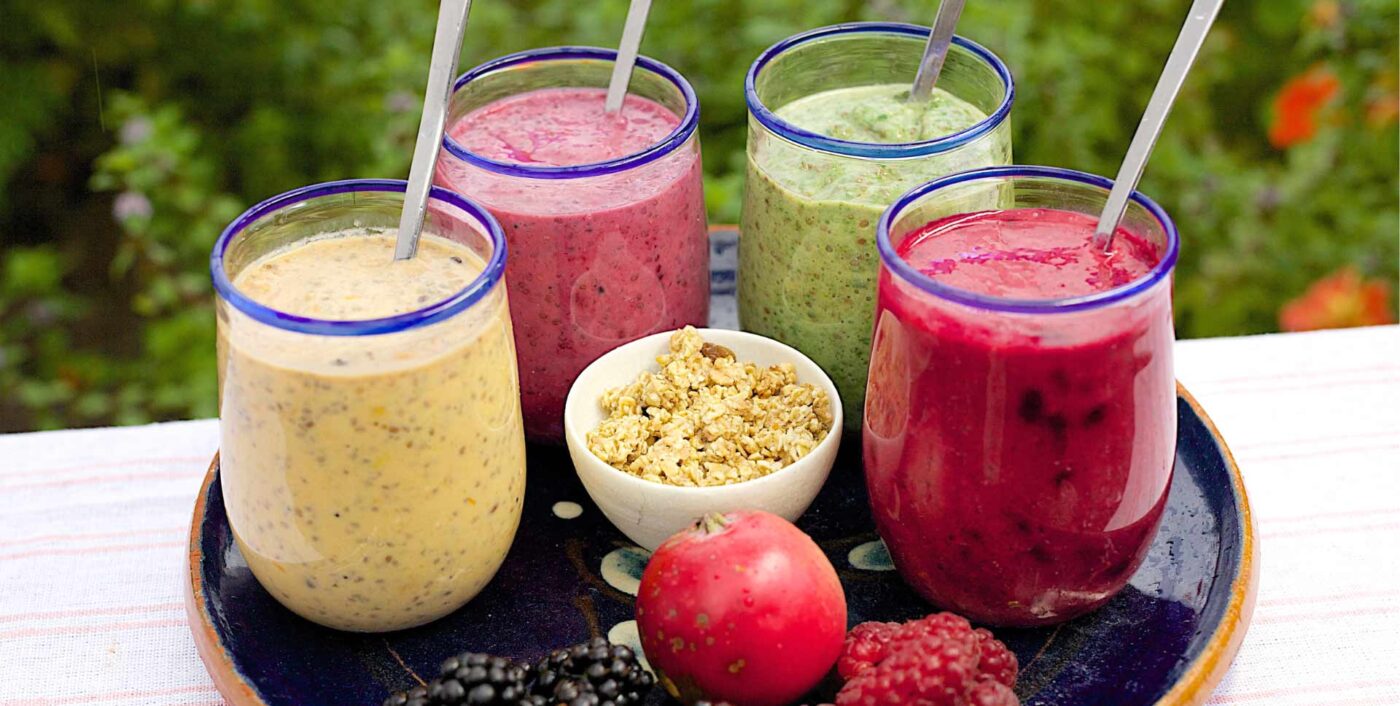
Pomegranates, blueberry and acai berry are all extremely rich in antioxidants. They also go great together in a smoothie!

Acai (pronounced “ah-sigh-ee”) is a tiny berry that grows on a species of palm tree in Brazil. It is praised for it’s super high antioxidant load and possible disease-fighting phytonutrients. The flavor is sometimes described as a combination of red wine and chocolate. The berry is low in sugar too.

Acai, with it’s “red wine and chocolate” flavor mixes well with pomegranate and blueberries to provide a rich, complex flavor.

Super Antioxidant Blast Smoothie Recipe

  • 1/4 cup fresh pomegranate juice (Juice from one large pomegranate.)
  • 1 oz (2 tablespoons) whole acai berry juice *
  • 2 cups frozen wild blueberries
  • 2 organic bananas
  • 4 ounces filtered water (optional if needed)

Blend on high for 30 seconds or until smooth. To juice the pomegranate, simply empty the seeds in a strainer and smash them with a spoon. Make sure you place a metal bowl under the strainer. Pomegranate juice stains, so be careful!

You can use bottled pomegranate juice but I prefer juicing it myself since it will not have been pasteurized and I know that it’s fresh and the most potent in antioxidants.

I chose to use frozen blueberries to make this a cold smoothie, but you can use fresh if you’d like.

As with most of our smoothie recipes, you can make this a green smoothie by adding fresh baby spinach, romaine lettuce or other leafy green of your choice. Strong, bitter greens like kale or dandelion might interfere with the flavor of this particular blend.

* I used concentrated acai juice made from whole berries. You can find acai berry juice (or powder) at health food stores, usually in the supplements aisle.

Nutrition Information *

Calories: 391
Fat: 1g
Protein: 3g
Carbohydrates: 102g
Calcium: 5% RDA (Recommended Daily Allowance)
Iron: 2.6 mg
Vitamin A: 13% RDA
Vitamin C: 33% RDA

This smoothie is also a rich source of many antioxidants, vitamin B3, B5, B6, copper, magnesium, manganese, potassium and zinc.

* The nutrition information for this smoothie recipe is approximate. Since acai berry hasn’t been extensively studied and does not appear in the USDA Nutrient Database, it was not included in the nutrition information above. Acai berry powder, juice and whole, fresh acai berries will have different nutrient profiles due to differences in processing and freshness.

Browse more blueberry smoothie recipes or submit your own

  • Twitter
  • Facebook
  • Delicious
  • StumbleUpon
  • Yahoo Buzz
  • Digg
  • Reddit
  • Google Reader
  • Google Bookmarks
  • Technorati Favorites
  • Squidoo
  • MySpace
  • Share/Bookmark

Tags: , , , , ,

This is a really easy and tasty smoothie using the antioxidant-rich fruit of the prickly pear cactus native to Mexico. Cactus pears have deep red flesh and are quite tasty. They also make your smoothies look beautiful with a deep red hue.

I recommend using a high-speed blender when blending cactus pears because the seeds might make a “gritty” smoothie in a standard blender. It’s similar to pomegranate. If you don’t have a high-speed blender, then juice the pear and make smoothies with the juice and pulp (without seeds).

Cactus Pear and Banana Smoothie Recipe

  • 1 banana
  • 1 cactus pear
  • 4 oz filtered of water

Blend on high for 30 seconds until smooth. This makes a smoothie for one. You can easily double or triple the recipe. Just add an extra banana and cactus pear.

Watch out when you handle these spiny fruits! You’ll definitely want to peel them first.

Feel free to add greens to this smoothie. Some fresh, raw baby spinach would blend well as well as a small head of butter lettuce.

Nutrition Information

Calories: 147
Fat: 0g
Protein: 2g
Carbohydrates: 36g
Calcium: 6% RDA (Recommended Daily Allowance)
Iron: 3% RDA
Vitamin A: 5% RDA
Vitamin C: 33% RDA

This smoothie is also a rich source of folate, vitamin B6 and magnesium.

Browse more banana smoothies or submit your own.

  • Twitter
  • Facebook
  • Delicious
  • StumbleUpon
  • Yahoo Buzz
  • Digg
  • Reddit
  • Google Reader
  • Google Bookmarks
  • Technorati Favorites
  • Squidoo
  • MySpace
  • Share/Bookmark

Tags: , , ,

Crisp romaine lettuce is a highly nutritious leafy green to use in a green smoothie. It has a mild flavor that is easily masked by fruit so it’s perfect if you’re new to green smoothies or making it for picky eaters.

You can add an entire head of lettuce to a fruit smoothie and not impact the taste at all. I typically toss in an entire head of romaine in my morning smoothie. It provides 106 calories and gives me a super jolt of nutrition first thing in the morning.

Here are some surprising nutrition facts about this wonderful smoothie (and salad) green:

1 – Protein. Believe it or not, romaine lettuce is 17% protein with 7.7 grams per head. It is also a complete protein! That means that it has all 8 essential amino acids, 9% RDA of some and up to 26% RDA of others.

2 – Calcium. One head of romaine has 206mg of calcium (about 21% RDA). Blend it with calcium rich fruits like papaya and oranges and you’ll get more calcium than a glass of milk!

3 – Omega-3s. One head of romaine lettuce contains 44% RDA of Omega-3 essential fats. Forget the tainted fish oils, reach for some leafy greens instead!

4 – More Vitamin C Than An Orange. One head of romaine contains 167% RDA of vitamin C while an average sized orange contains only 92%.

5 – Iron. One head of romaine contains 6mg of iron, which ads a significant source of iron to the diets of vegetarians and vegans.

6 – Romaine Lettuce is Rich in B-vitamins: Thiamine (B1) – 38% RDA, Riboflavin (B2) – 32% RDA, Niacin (B3) – 12% RDA, Pantothenic Acid (B5) – 18%, Pyridoxine (B6) – 36 %, Folate (B9) – 213%!

7 – Water. One head of romaine provides 16% of your daily water needs with about 20 ounces of water per head!

8 – Rich Source of vitamn A (as beta-carotene) and K. As with most leafy greens, romaine is super rich in beta-carotene with 1817% RDA per head and has 535% RDA of vitamin K.

9 – Low Levels of Oxalic Acid. If you have problems with calcium oxalate kidney stones, romaine lettuce might be a good choice for leafy greens since it is very low in this anti-nutrient.

10 – Mineral-Rich. Don’t let the lighter color of romaine lettuce fool you. This not-so-dark leafy green is rich in minerals. One head contains copper (33% RDA), magnesium (22% RDA), manganese (42% RDA), phosphorus (27% RDA), potassium (33%), selenium (5% RDA) and zinc (13% RDA).

How To Select And Store Romain Lettuce

Choose bright, crisp heads of romaine lettuce. Avoid bunches that have rust, holes or that are limp, wilted or yellowing. It is common to find romaine that has slight browning along the very edges of the outer leaves. This is okay as long as the rest of the head looks fresh and green. I just trim the brown edges off the outer leaves.

Romaine is highly perishable. I store it in the fridge in a large plastic tub with a piece of paper towel to absorb excess moisture and condensation. My lettuce will keep for up to 5 days this way. If you store wet lettuce in a produce bag, it will likely only last a couple days.

Whenever possible, choose organic romaine (sames goes for any leafy green) as greens are often high in pesticide residue.

How To Use Romaine In A Green Smoothie

I use the entire head, including outer leaves. Wash each leaf and then add to your smoothie. I recommend that you add the fruit and blend it first, then add the lettuce so that it blends easily.

Because of it’s delicate flavor, lettuce is easily masked by just about any fruit you can think of. My usual recipe calls for 2-3 bananas, 1 mango, 1 tablespoon of flax, a few frozen strawberries (or 1/2 cup frozen blueberries) and an entire head of romaine. Now THAT is the breakfast of champions!

  • Twitter
  • Facebook
  • Delicious
  • StumbleUpon
  • Yahoo Buzz
  • Digg
  • Reddit
  • Google Reader
  • Google Bookmarks
  • Technorati Favorites
  • Squidoo
  • MySpace
  • Share/Bookmark

Tags: , , , , , , , , , , , , , , ,

In this episode of Green Smoothie Q&A, I answer a viewer’s question about green smoothies and diabetes.

Also, I share my experiences with using broccoli and cauliflower in green smoothies. You might be tempted to use these vegetables, but the results may vary depending on your blender or tastes.

If you have a question to ask that you would like me to answer in an upcoming video, visit our contact page.

  • Twitter
  • Facebook
  • Delicious
  • StumbleUpon
  • Yahoo Buzz
  • Digg
  • Reddit
  • Google Reader
  • Google Bookmarks
  • Technorati Favorites
  • Squidoo
  • MySpace
  • Share/Bookmark

Tags: , , , , , , , ,

Also known as seaweed, sea vegetables resemble plants but are actually varieties of algae that grow in the ocean as well as fresh water. The most popular are kelp, nori, dulse, wakame, kombu and hijiki. Sea vegetables are usually found in health food stores, although some mainstream grocery stores carry them as well. I’ve recently started adding sea vegetables to my green smoothies because they have some great health benefits.

Sea Vegetable Nutrition and Health Benefits

Sea vegetables are a good source of minerals and trace minerals. They also contain good levels of magnesium, potassium, folate, vitamin K, calcium and iron as well as protein. They are especially rich in iodine which is crucial for a healthy metabolism and thyroid function. Just one teaspoon of dulse flakes contains over 100% of your daily value of iodine! Kelp is also rich in iodine with one serving having well over 100% DV.

Many sea vegetables contain vitamin B12, however, most experts agree that the vitamin B12 present isn’t available to humans because it is in an analogue form. Therefore, vegans should not assume they are getting enough vitamin B12 from algae and sea vegetables.

How To Use In Green Smoothies

Kelp powder and dulse flakes are the easiest of the sea vegetables to use in a green smoothie. Simply add a half to a full teaspoon to your smoothie and blend. Since most seaweeds have a somewhat salty, “ocean” flavor, you don’t want to add too much. However, a teaspoon or so doesn’t negatively impact the flavor of a fruit smoothie at all. I actually really like it. It cuts the overall sweetness of the fruit without asserting any sort of saltiness or “marine” flavor. It won’t make your smoothie taste “fishy” as long as you don’t add several heaping tablespoons of the stuff!

Other sea vegetables are available as dried whole leaves or strands and if you have a high speed blender like the Vita-Mix or Blendtec, you can probably add a piece and blend. Otherwise, it’s probably best to soak in water for a bit to soften up and then add them to your green smoothie. Re-hydrated kelp is delicious and not salty. Add a few strands and blend up in any smoothie recipe and feel free to combine with other leafy greens. Nori sheets (the ones typically used for making sushi rolls) are not the most nutritionally-rich choice, so I don’t use them in smoothies.

You can add sea vegetables to just about any green smoothie recipe. I added a teaspoon of dulse flakes to a green smoothie that had 3 bananas, 1 mango, 4 strawberries and one head of romaine lettuce. The smoothie was delicious and did not taste like the ocean at all.

How To Select and Store Sea Vegetables

Sea vegetables can be found at most health food stores, Asian markets and in some regular supermarkets. You will most often find them in the “International” section with Asian foods like noodles and tofu. They come dried and pre-packaged. Most need to be soaked before consuming, although you can eat most of them as-is. Dulse also comes in dried flakes which makes it easy to sprinkle. Kelp comes in powdered form which is convenient for adding to smoothies, but I prefer whole kelp to powder for overall freshness and potency of nutrients.

It is vitally important to choose organic sea vegetables whenever possible. The reason for this is that seaweeds have a great ability to absorb minerals from the water around them. Unfortunately, they also absorb all the bad stuff in the water around them too including heavy metals (mercury, arsenic) and other contaminants. Certified organic sea vegetables should be tested for heavy metals, fuel oil residues, PCB’s, pesticides, herbicides and bacterial contaminants.

When selecting sea vegetables, choose organic and check the packaging to see that the company tests for contaminants. Also, look for brands that dry using low temperatures. Choose untoasted over toasted whenever possible to preserve any nutrients that might be affected by exposure to heat or cooking.

Store in a cool, dry place out of direct sunlight.

  • Twitter
  • Facebook
  • Delicious
  • StumbleUpon
  • Yahoo Buzz
  • Digg
  • Reddit
  • Google Reader
  • Google Bookmarks
  • Technorati Favorites
  • Squidoo
  • MySpace
  • Share/Bookmark

Tags: , , , , , , , , , , , ,

Here’s another tropical fusion smoothie with banana, papaya and strawberries! You can add greens to it if you want, but I just made it with fruit this time. It’s a refreshing tropical drink on a hot, summer day.

Papayas are rich in antioxidants and the enzyme papain, which helps promote digestive health. Lycopene content of papayas may help protect against prostate cancer.

Strawberries are high in vitamin C, antioxidants and manganese.

Studies suggest that bananas may prevent high blood pressure and decrease risk of kidney cancer. Bananas also promote the growth of beneficial intestinal bacteria and they have a natural antacid effect, so a banana smoothie might just be the thing to ease heartburn. Read more about why bananas are so good for you.

This is a supper simple, supper healthy smoothie!

Banana-Papaya-Strawberry Smoothie Recipe

  • 1 banana, peeled
  • 2 cups of papaya, cuped
  • 1 cup of sliced strawberries
  • 4 to 6 ounces of filtered water

Blend on high for 30 seconds or until smooth. You can make it cold by adding frozen strawberries, adding a few ice cubes or putting it in the freezer for about 10 minutes.

Nutrition Information

Calories: 372
Fat: 1g
Protein: 5g
Carbohydrates: 94g
Calcium: 9% RDA (Recommended Daily Allowance)
Iron: 1.6 mg
Vitamin A: 108% RDA
Vitamin C: 324% RDA

This smoothie is also a rich source of folate, vitamin K, copper and manganese. Adding 2 cups or handfuls of greens will boost the calcium, iron, vitamin and mineral content of this smoothie. I recommend fresh baby spinach, kale, chard or even dandelion greens!

Browse more papaya, banana or strawberry smoothie recipes or submit your own

  • Twitter
  • Facebook
  • Delicious
  • StumbleUpon
  • Yahoo Buzz
  • Digg
  • Reddit
  • Google Reader
  • Google Bookmarks
  • Technorati Favorites
  • Squidoo
  • MySpace
  • Share/Bookmark

Tags: , , , , ,

Here’s another episode of Green Smoothie Q&A where I answer a viewer’s question about why your mouth and throat might be irritated after eating kiwi fruit.

Also, is it okay to use packaged coconut water instead of chopping into a fresh young coconut to save time?

If you’ve got a question about green smoothies, health or nutrition, just using the Contact Page.

  • Twitter
  • Facebook
  • Delicious
  • StumbleUpon
  • Yahoo Buzz
  • Digg
  • Reddit
  • Google Reader
  • Google Bookmarks
  • Technorati Favorites
  • Squidoo
  • MySpace
  • Share/Bookmark

Tags: , , , , , ,

I never really thought about using romaine lettuce in a smoothie until I found out that one head of romaine has about 7-8 grams of protein, 6 mg of iron and 21% RDA of calcium! Romaine doesn’t have a strong flavor either, so it’s easily masked by fruit in a smoothie.

I usually add the entire head, but I only added half to this smoothie recipe. If you’ve been drinking green smoothies for a while, go ahead and stuff the entire head in the blender!

Strawberry Mango with a hint of Pineapple Smoothie Recipe

  • 2 and 1/2 cups organic strawberries
  • 1 cup pineapple
  • 1 large ripe mango, peeled
  • 1/2 head romaine lettuce (or use the whole head)
  • 4 to 6 ounces filtered water

Blend on high for 30 seconds or until smooth. If you want to make this a cold smoothie, you can always use frozen strawberries or just add a couple of ice cubes.

Nutrition Information

Calories: 385
Fat: 2.8g
Protein: 8g
Carbohydrates: 94g
Calcium: 20% RDA (Recommended Daily Allowance)
Iron: 5.3 mg
Vitamin A: 966% RDA
Vitamin C: 470% RDA

This smoothie is also a rich source of folate, vitamin B1 – vitamin B6, vitamin E, vitamin K, copper, magnesium, manganese, phosphorus, and potassium.

Browse more pineapple, mango and strawberry smoothie recipes or submit your own

  • Twitter
  • Facebook
  • Delicious
  • StumbleUpon
  • Yahoo Buzz
  • Digg
  • Reddit
  • Google Reader
  • Google Bookmarks
  • Technorati Favorites
  • Squidoo
  • MySpace
  • Share/Bookmark

Tags: , , , , , , ,